The Priestess
II – Gimmel – Moon – Camel
Bridge Between Worlds, Silent Guide, Calm Security, and Bastion of Esoteric Knowledge
The Priestess – or High Priestess – third of the Major Arcana, corresponds to the Hebrew letter of Gimmel. The letter Gimmel symbolizes a man running; more specifically, a wealthy man running to catch a poor man to reward him. The letter signifies also a journey, as emphasized in its original pictographic meaning as “camel.” More specifically, this journey is that made between the divine and mortal realms, relatively frequently. It is not exactly like the Fool’s journey of self-discovery, for the Priestess does not seek to unify the world, but just travel between them. Indeed, she herself stands behind a veil, the division between the two worlds, and keeps the mysteries of the divine realm from the mortal worlds. She acts as a sort of judge, giving out punishment and reward in order to restore the balance of the soul (as also hinted at by the meaning of Gimmel). She is the bridge between the two realms, who imparts divine wisdom upon those who ask. She represents also generosity and the passing of secret, esoteric knowledge to others.
She is the counterpart of the Magus; they both are teachers, but in different ways. The Magus actively steps out into the world and trumpets his message, but the Priestess sits impassively in her table, letting her students come to her. She is more mystical and mysterious. Her astrological element is the Moon, and she herself embodies the aspect of the Moon referring to the Eternal Virgin of Artemis. She is a blank slate on which the sun’s light is reflected; she makes it possible for others to realize their full potential. She is a calm source of security, and is completely in control of her emotions. She is the feminine to the Magus’ masculine, and represents also the steadiness of the lunar cycle. She is the blank slate that the Magus uses to realize his own potential, and may have even taught him herself.
The Priestess stands behind a veil in the Thoth art, which has in front of it offerings of fruit and gems from students seeking to learn her secret knowledge. A camel – homage to her association with Gimmel and the journey through life that she helps guide people through – is also present there. She herself stands calm and partially hidden and clouded by the veil. Her virginity is seen in the bow of Artemis lying across her legs, and she holds her hands forth in either an embrace or supplication. The Rider-Waite shows a similar image, with a calm, serene Priestess seated upon a chair, the paper in her hand partially obscured, and the moon at her feet. Behind her are the fruits seen in the Thoth art, which also can represent her nurturing aspect; she teaches by looking after the safety and security of her flock.
The Priestess represents the hidden mysteries in life, and the passive teaching style. She focuses on the inner self, in opposition to the Magus’ focus on the exterior. The Magus represents the conscious will and manipulation of the world, while the Priestess represents the unconscious influence and one’s unintended influence on the world. She helps one realize their full potential and provides them with a secure realm in which to do it. She directly channels the light of the Sefirot of Kether (Spiritual Perfection and Emanation) into the Sefirot of Tiphareth (Balance and Conscious Harmony) in her role as the path between those two Sefirot in the Tree of Life. Her divine knowledge from Kether, passively passed on to those in the more material world, helps others achieve the balance and harmony of Tiphareth consciously; she is the silent guide, always obscured behind the veil. She represents also the mysteries of life, and secrets. She possesses hidden knowledge, and may share it with you. She is also the symbol of femininity, and the mysteriousness, passivity, and inward focus commonly associated with it.
In a reading, this card asks you to examine the role of secrets, mysteries, and forbidden knowledge in your life. Do you know something that maybe you shouldn’t? It also asks you to think about how a calm sense of security might affect your life, or perhaps how a helping guide might help you get your life back on track. Reversed, this card’s energies are blocked, hidden, or twisted somehow; is your guide leading you astray? Is your serene security perhaps not so secure – or serene? Will your forbidden knowledge lead to your ruin?
The Magus
I – Beth – Mercury – House
Activity, Knowledge, Teaching/Prophecy, and Will
The Magus – Magician in the Rider-Waite tradition – is the second of the trumps, following the Fool. The Magus corresponds to the second Hebrew letter, Beit. Beit is the first letter of the Tanakh (rather than Aleph, the first letter of the Hebrew alphabet), and so is in a way associated with the act of creation. The original pictographic meaning of the letter Beit is that of house or tent; specifically the house of the Lord. This again ties back to the idea of creation, as God created his Temple (his house) so that he would have somewhere to reside in the lower realms. His “house,” though, consisted of all of the Jewish people, each of whom carried a part of the Lord with them. The Hebrew people were created so that God could dwell in them and also so that they might conquer and make for themselves a kingdom in the name of the Lord. The Magus is in control of his own inner house; he is the Master of the House.
The Magus, then, represents the divine spirit in each and every one of us. The Magus is the House of the Lord, providing the link between the mortal realm and the higher realm. While the Fool seeks a union of the two realms through ascension, the Magus seeks a union through descending. In the Rider-Waite art, the Magus holds aloft a two-sided candle in one hand, while the other points down at the ground; a common symbol of channeling divine power from above down to the Earth. In serving as this bridge of sorts, the Magus represents both Air (Heaven) and Earth (Earth), applying the vast array of knowledge he has to the art of creation, as seen by the four tools on the table before him: a wand, a cup, a sword, and a pentacle – the four suits making up all of existence. The Magus is an active manipulator, using his intelligence and knowledge to actively manipulate the world around him. The Magus’ chosen tool is the Wand, associating him with Fire – yet at the same time, he is also the epitome of the intellectual, and so is associated also with Air. In his function as the representative of the divine on Earth, he also represents the grounding of divine logic, and so is associated with Earth.
The Magus is represented in Astrology by Mercury. Mercury – or Hermes, or Thoth – is the messenger of the Gods, active and swift, able to move and speak with great clarity and reason. He is well-loved, as be brings people the Word, and has great charisma. He represents energy sent forth, and the outer aspects and image that one projects. He has tremendous force of Will, He is a fabulous orator, able to convince others to follow him, and also is a tremendous intellectual and scholar. He knows everything about the world, and knows also how to manipulate it (Mercury is known as being a trickster of sorts as well). The Magus is wise, and is able to think and express himself clearly over any medium. He is capable and confident, able to create, manipulate, and judge.
The Magus also represents in many ways the “ideal” man; confident, assertive, knowledgeable, creative, active, and wise. He knows the mysteries of the divine and is close to Hod through his knowledge; he is the counterpart of the High Priestess. Unlike her, he is not half-hidden or mysterious; he feels no need to hide his power, and strides confidently through space, doing what he wills. This can be seen clearly in the Thoth art, as the wing-footed Magus floats through space, creation stretching all around him, reaching out and interacting with everything (again, the four suits appear on this card). He is also a sort of prophet, able to spread divine words of wisdom to others, as he has knowledge of infinity (the symbol of infinity appears above his head in the Rider-Waite card, and the caduceus appears. His words, however, can be distorted and misheard by others, as seen by the Ape at his feet.
When looking at the Tree of Life, the Magus is the path between Kether (Spiritual Perfection and Emanation) and Binah (Understanding and Potential). In this regard, his role as bringer of the divine Word from Kether to allow others to understand their potential is emphasized. He connects the wisdom and Perfection of Kether to the Understanding and Potential of Binah, serving as a teacher and mediator between the intellectual realm of understanding and the spiritual truth behind things, using the energy of Kether to actively bring the message of God to the masses (Binah can also represent duality and passivity) who listen attentively for enlightenment.
In a reading, this card asks you to examine the role that activity, conscious manipulation, and words of wisdom play in your life. It suggests that you think about how messengers have influenced your life, and of how you influence the world around you and project an external image of yourself. Reversed, this card’s energies are blocked, hidden, or twisted somehow; the Magus in your life is hidden, or you do not hear their magic. Maybe you are unconsciously changing the world around you to a far greater extent than you mean to. Reversed, the Ape of Distortion becomes dominant, and the true words of the Magus are distorted and misunderstood.
The Fool
O – Aleph – Air – Ox
New Beginnings, Innocence, Faith, and Curiosity
The Fool is the first of the Major Arcana, and also some would argue the end. It corresponds to the Hebrew letter Aleph, one of the three mother letters. The letter Aleph is made up of two of the letter Yud, both separated and joined by a single Vav set diagonally. The two Yuds represent high (wet) water and low (cold) water, which in turn represent higher realms (Heaven) and lower realms (Earth). The Vav between them represents the place between the two realms, both dividing them and connecting them. This letter, then, represents the joining of higher and lower realms; the ascension of the lower and the descending of the higher. The Fool corresponds to this letter because he also represents this union of two worlds. He dwells in the lower world, and seeks to reach the higher world through gaining knowledge and experience. The Fool is on a quest; he has started a journey and is attempting to reach a higher level of understanding, thereby crossing the bridge between worlds, travelling from one Yud to the other through Vav. He seeks to become whole and complete, the union of Man and God.
The letter Aleph – and then, by extension, the card of the Fool – is also associated with the element of Air. He lives in a world of fantasy, sometimes heedless of the dangers before him on his quest (as can be seen in the Rider-Waite art, where he appears to be about to step off of a cliff, and ignores the yapping dog at his heels). He has grand dreams before him (see the flower in the Rider-Waite art) and idealized notions of what the world will be like; he starts out on his journey as being quite the actual fool, naive, easily led, and dreamy. He doesn’t know what he’s getting himself into. But, like the element of Air represents, he is a very thoughtful person, to whom reality has little concern, and who is instead concerned with fulfilling an abstract ideal, and discovering who he is himself.
Despite these airy connections, however, the letter Aleph also, in its original pictographic form represented an Ox; a very Earthy animal. So, this way, the Fool is both the beginning and the end, as the element of Earth represents new beginnings, which in turn imply old endings. The Ox is also a stubborn and strong animal; the Fool’s naivete will allow him to blissfully and stubbornly push onwards against all odds. He charts uncharted territory, and like the Ox, serves as a leader, opening the way for others to follow.
The Fool represents, in its simplest forms, new beginnings. He can represent the beginning of a journey, a quest for discovery, or of creation. The Thoth Fool better illustrates the Fool’s special connection with God, as pointed out by Aleph’s association as the Father letter, the first and most humble of the Hebrew alphabet, and the closest to God. In the Thoth art, the fool stands at the center of an outward spiraling of energy, indicating the infinite. He appears simultaneously as a man and as a divinity, from which energy emanates to fill the world. His creation is not the intentional and well-planned creation associated with the Magician, but rather creation done almost mindlessly and unintentionally, creating wondrous new beginnings without thinking much about its implications. He is innocent and has complete faith in the world; he does not even try to protect himself from it, as he cannot imagine that it will harm him. The Thoth art also shows a beast worrying at the leg of the fool, but he is so wrapped up on creating a new beginning for himself that he seems not to notice. He is surrounded by symbols of innocence, such as flowers, butterflies, and a dove, and the world forms itself only in the areas already touched by the energy emanating from him.
The Fool is also curious, willing to set out and explore everything around him on a quest for knowledge. He may appear mad to some, but he himself knows what he is doing. He is a wanderer seeking to find himself, and has the potential to become someone great, and actively seeks to realize said potential. In this way, he is divinely inspired; he is the childlike god, possessing much power and not realizing it (think Haruhi Suzumiya here). He is the Man-God, incorporating elements of realms both divine and mortal.
In the tree of life, the Fool corresponds to the path between Kether (spiritual perfection and emanation) and Chokmah (first manifestation and pure harmony). He stands on the first path of the Sefirot, fitting his position as the first trump. He comes out of the creation of Kether and immediately takes action – such as is represented by Chokmah – to learn all he can. He is a student, and represents the energy of the suits as they pass through the Sefirot, and he himself experiences the effect of every card. He also can be seen as representing the querent or the human condition.
This card, then, symbolizes journeys of all kinds, innocence, new beginnings, potential, naivete, air-headedness, curiosity, faith in fate and the world – it will take care of you and itself – and a sort of mystical madness; the sort that comes from a man unwilling to admit defeat in his quest to reach a higher plane of understanding. In a reading, this card asks you to examine the roles that folly, naivete, and curiosity play in your life, and may advise you to look for a new start in your life, go on a journey or travel somewhere, and to just close your eyes and take the plunge, trusting that you’ll be okay. Reversed, this card’s energies are blocked or twisted somehow; perhaps your journey or new beginning will have to wait a while. It is very difficult to read this card as negative; the folly that this card represents is not ignorance (that’s the realm of the Devil), but rather that of choosing to ignore the troubles of the world, which in itself is a positive thing; this card is extremely optimistic.
The Court Cards of the Tarot
There are four suits in the Tarot, and each suit has Four Court Cards, each card representing a personality that illustrates a different aspect of their suit. These four personalities are the fiery, watery, airy, and earthy parts of Fire, Water, Air, and Earth. The Knights are all the “fathers” in their family, representing the fiery, active personalities found in their suit. The Queens are the “mothers,” who represent the watery, passive personalities of each suit. The Princes are the eldest children, representing the airy, intellectual personalities found in each suit. The Princesses are the younger children, representing the Earthy, practical personalities found in each suit. Each group of four cards within a suit defines a family.
The Family of Wands
The family of Wands is that of a royal dynasty. The patriarch, the Knight of Wands, is the Fire of Fire, and is an active and passionate man. He is new to his throne, having married the old queen, and so has much to prove and tries to do so as quickly as possible. He is impulsive and prideful, but is willing to do whatever needs to be done to rule with Strength.
His wife is the Queen of Wands, and she is the Water of Fire, who embodies the qualities of the Suit far less actively than her husband. She is the older ruler, and acts like a cat; she is charming, competent and everyone loves her for the qualities she embodies and the charisma she had, but she can be vindictive and tyrannical is raised to anger, and is aloof from the people, unlike her husband.
Their first child is the Prince of Wands, who takes advantage of what he has and uses his smoldering charm to cause others to love him, but he views them all as play-things, and he often amuses himself at the expense of others; his attention is powerful, but fleeting.
Their second child is the Princess of Wands, who is more logical and sensible than her air-headed brother. She does what needs to be done for the good of the kingdom, and explores new frontiers and does what no one else will dare to do, earning her admiration.
The Family of Cups
The family of Cups is that of a noble family. The patriarch, the Knight of Cups, was raised as an only child, and is kind-hearted and wants to help those around him, but isn’t sure how he can. He is unsure of himself, but has visions of grandeur and of going out to change the world, but never actually goes out and does it, instead engaging in flights of fancy. He is kind and generous when others come to him, but he will not seek others out.
His consort, the Queen of Cups, holds frequent audiences in her private chambers, where she spends most of the day dreaming behind her veil. She deliberately keeps herself mysterious, and allows people to ask her favors, which she will then grant them. She knows how to help people, and instantly makes connections with people, understanding their emotions. She helps them realize who they are, and then returns to her state of blissful dreaming.
Their eldest child, the Prince of Cups, is a talented artist and gifted individual, who everything comes naturally to, but who also tends to remain aloof from others, expressing himself and connecting with them through his works of art, which are admired by all.
His sister, the Princess of Cups, is a partyer. She is often full of wise words of advice, like her mother, but they are often hard to understand as she is constantly lost in ecstasy, having given over to debauchery and a state of eternal rapture. She is easily taken advantage of and given to worldly pleasures, spoiled by her parents and ignored by her brother.
The Family of Swords
The family of Swords is a family of dedicated freedom fighters. The patriarch and father, the Knight of Swords, is devoted to a cause completely and utterly, ignoring his family in order to help bring about his glorious vision of equality. He is very intelligent and deeply idealistic, and goes out into the world to try to change things to make the universe more right. His actions are, however, self-destructive, and will lead him to ruin as he fights authority and the rest of the world.
His wife, the Queen of Swords, is a very independent-minded and capable woman, a result of her husband never being around. She, shares her husband’s vision of the future – indeed, he couldn’t stand her if she didn’t – and is equal to him in their household. She, however, prefers to bring about their shared ideal reality through less aggressive means, by brokering peaces and slowly spreading her ideas. She serves as an arbiter of disputes and a diplomat, able to understand the source of any conflict and choose the best course of action to solve it.
They have too children, both raised to believe in their parents’ ideals. Their son, the Prince of Swords, believes that their theory for the future needs to be sound and well thought-out before action is taken, and so locks himself in his ivory tower, constantly thinking up new theories about the universe have long since ceased to have any practical application. He is a genius, and no one else – not even his parents – understand half of what he says. He has long since left reality, lost in his own thoughts, having nothing or no-one to ground him.
His younger sister, the Princess of Swords, helps her mother manage the household in her father’s absence. She is clever and possessed of a low cunning, and is willing to compromise some of her principles in order to get something closer to what she dreams of. She is able to come up with lots of ideas, like her brother, but hers are very practical. She is a fantastic manager, able to put her clever ideas into practice, and is a positive asset to her parents, even if she can be petty and vengeful at times.
The Family of Disks
The family of Disks is a family of businesspeople. The patriarch, the Knight of Disks, got to where he is today – a wealthy, successful businessmen and entrepreneur – through careful saving, hard work, and calculated risk. He is very cautious, but willing to take a risk when the chance of failure is minimal and the rewards are great. He is very logical and also stubborn; he will never admit he’s wrong, and will always have his way, as he brings home the most bread.
His wife, the Queen of Disks, is the perfect hostess, and submits to her husband’s desires. She longs for something greater, but her husband is set in tradition and will not let her be anything greater. She helps everyone who comes to see her as much as she can, and gives so much of herself away that there is little left for her. She lives through the lives of those she helps, as she herself has no life to live outside her home. She spends her life helping others to realize their potential and assisting them on their journey trough life; she is a very good teacher.
Their eldest child, the Prince of Disks, is dull, slow-moving, stubborn, ponderous, but very intelligent; his mind just works at a slower pace than most others. He chooses his words carefully, and once he starts moving, can not be stopped. He is fantastic at solving problems, able to come up with clever solutions to any problem his father sets before him.
Their youngest child, the Princess of Disks, has been married off to another aspiring businessman, and she bears his child. She brings much potential wealth to her father’s and her husband’s families, and also carries the next generation with her. She is fierce and will not let anything harm her unborn child, as it is everything to her. She is beautiful, strong, and won’t take any nonsense. She knows how important she is, and she won’t let anyone forget it.
The Numbered Cards of the Tarot
There are four suits in the Tarot, and each suit has ten numbered cards. Each number corresponds to one of the Sefirot on the Kabbalistic Tree of Life and to a member of the Naples Arrangement. The energy of each suit journeys through these nine cards, revealing remarkably similar – and yet divergent – journeys from their birth to reality.
All four of the energies flow out from the eternal everything of EinSof; roughly analogous to God. The four energies – the Drive of Wands/Fire, the Emotion of Cups/Water, the Thoughts of Swords/Air, and the Materialization of Disks/Earth – all emanate from EinSof, and immediately enter the first of the numbered cards: the Aces of Kether.
Kether – Aces – Root – Position
The Sefirot of Kether represents the original emanation of each of the Suits’ energies as soon as they emerge from EinSof. It represents the Seed, the Link to previous generations, and the Root of what is to come. The energies of each of the suits at Kether represent the best each suit has to offer, and the untarnished, pure energy and idea of each suit. The Ace of Wands is the Origin, from which all creation emerges; it represents the beginning of everything, the will and drive that makes things happen. It is creation. The Ace of Cups is the Potential; the more passive Ace that helps the energy of the Ace of Wands realize its potential, and helps it along and shows it where to go. The Ace of Swords is the Thought; the energy of the Suit of Cups begins to find its own way without guidance, and starts realizing its own potential. The Ace of Disks is the Realization, when the energy of Suit of Swords finally becomes all it can be. The Aces all represent the starting points of their suits – the beginning, and the position that shows the first existence of something – and lay out a secondary pattern: that of Fire to Water to Air to Earth.
Chokmah – Twos – First Manifestation – Line
The Sefirot of Chokmah represents the first manifestation and the original harmony of each suit. The energy of each suit becomes active and attempts to assert itself upon the world. The Suit of Wands yields Dominion, as the fiery will of the Ace attempts to change the world and get things done, ruling over a domain as a lord. The Suit of Cups yields Love, as the emotional intimacy of the Suit comes forward and shows itself. The Suit of Swords yields Peace, as the intellectual and principled thoughts of the Ace come forward and shape the universe according to their views of an ideal world. The Suit of Disks yields Change as it sees – better than the other Suits – how to best exist the world, and establishes its stability through slow motion and adaptability. The existence of the Suits has become more defined now, and has become more than just a position; it is now two positions, forming a line.
The Lord of Fire (Dominion) comes forth and conquers a kingdom, and then realizes that he needs someone to share his realm with, and so finds someone to share his life with (Love). Together, the two halves of the dichotomy of Fire and Water bring balance to their domain, and there is peace (Peace). The realm remains stable through constant, slow motion and flexibility (Change).
Binah – Threes – Understanding – Plane
The Sefirot of Binah represents the birthing ground and understanding of each of the suits. It is like a nursery, where each suit begins to realize its potential and see what it can be. The Suit of Wands realizes that it can become filled with Virtue, and begins to embody these passive qualities. The Suit of Cups realizes that it can spread its love to more than one other person, and overflows with Abundance. The Suit of Swords realizes that its abstract principle cannot be applied practically to the real world, and fall into Sorrow. The Suit of Disks realizes that teamwork makes everything easier, and working with others allows it to create Works. A third point has been added to each suit, defining a plane, and allowing for more of it to be seen.
The courageous hero (Virtue) sets out to go make a name for himself in the world, and is loved and honored by those he meets – and he returns the favor, his world filled with love and life (Abundance). As his journey continues, however, he finds that he can’t do anything, and that not everyone is kind and sweet – he becomes disillusioned (Sorrow). However, he pulls himself together and realizes that he must still continue living and be happy, so works with others to overcome the problems in the world that he can fix, and make the universe a better place (Works).
Chesed – Fours – Stability – Matter
The Sefirot of Chesed represents the stability and condensation of the energies of each of the four Suits. The Suits have each seen what they can become and are now set out to try to become that. As such, they begin to stabilize themselves, forming their own identity with which to go out and do what they need to. The Suit of Wands makes allies to help it in its quest, and forges friendships in its quest for Completion. The Suit of Cups solidifies the gains it made by spreading love before, and settles down in a community and lives in Luxury, where it doesn’t have to worry about a thing. The Suit of Swords comes to terms with its lack of real potential, and strives to do what it thinks should be done anyway, and attempts to return to a state of peace through the establishment of Truce. The Suit of Disks takes its new goals seriously, and builds itself an immovable base of operations and Power from which to operate. The third dimension has now been added with a fourth point, and matter can now be present.
The Lord of Wands forces new friendships and sees what life is really about, reveling in the joy and stability of life (Completion). He is warmed by the presence of his friends and allies, and forgets all of his cares (Luxury). His few enemies he holds off so he can enjoy his youth through compromises (Truce), and while his enemies stay away he also builds up his power base (Power).
Geburah – Fives – Upset – Motion
The Sefirot of Geburah represents the instability brought about be destabilizing motion. The four Suits have all built up their stability, and then something comes along and upsets it. The Suit of Wands finds its allies all leaving him as they fall victim to infighting and Strife. The Suit of Cups loses its luxury and sees that luxury wasn’t even all it hoped it would be, and feels a sense of Disappointment. The Suit of Swords finds its truces broken and the reality of the world shattering its fragile peace, causing the Suit to suffer Defeat. The Suit of Disks’ stability is shattered suddenly, and it has nothing left, and suffers great hardship and gives in to Worry. The creation of the third dimension in the Sefirot of Chesed now allows for the full range of motion within the space, and everything is no longer still.
A person loses his friends as they turn on him and begin fighting themselves (Strife), and is saddened and made depressed as his expectations are smashed (Disappointment). They throw him to the ground and take everything he has (Defeat). Having nothing left after what amounted to an earthquake shattered his fortress of confidence, he doesn’t know what to do next (Worry).
Tiphareth – Sixes – Conscious Harmony – Experience
The Sefirot of Tiphareth represents a harmony and balance achieved through conscious effort, by resolving the instability brought about by Geburah by following the divine guidance of Kether. The Suits are restored to their former glory, and find their balance and strive to exist as best as they can in the world. The Suit of Wands unifies those who fought among themselves by showing them its own glory and ability to achieve Victory, eliminating any doubts they might have about them while forcing them to work together to win. The Suit of Cups revises its expectations of what to expect from life, and finally has its expectations fulfilled and enjoys a sense of Pleasure in everything it does. The Suit of Swords learns from its failures, and begins a process of trial-and-error that lead to develop the principles of Science, to advance the knowledge and state of the world. The Suit of Disks doesn’t give up, and though it has nothing, slowly works its way back up from nothing and achieves great Success and material gain. As things move through the space created by Chesed, they invariably will be in different places at different times, and this development of chronology and causation leads to experience.
The heroic Lord of Flames achieves a great victory with the help of others and unites people behind him (Victory), and his success fills him with joy and pride (Pleasure). With the re-establishment of some form of peace, he finds ways to advance the world and help him maintain his triumph (Science). He can stand back and admire what he has done then, for he has done all that he set out to do (Success).
Netzach – Sevens – Degenerate Weakness – Bliss
The Sefirot of Netzach represents a degenerate weakness that becomes apparent in the balance of Tiphareth. The Suits, enjoying their respective triumphs from before, have settled in and become too comfortable, taking too much pleasure in their achievements, and descending into degenerativity. The Suit of Wands, flush with the triumph of victory achieved by working with a group, goes off and tries to win individual victories for itself in an attempt to stroke its own ego and boost it above the rest, earning itself Valour. The Suit of Cups, filled with the pleasures of life, loses itself in ecstasy and descends into Debauch. The Suit of Swords again runs into the problem of the world being imperfect as its scientific process of trial-and-error shows that not everything can be accomplished and made good, and begins to realize the Futility of its endeavor. The Suit of Disks becomes too attached to its success and material gain, and does everything it can to keep it, even at the expense of others, leading to corruption and eventually to suffering Failure as what it has is taken away in a vain attempt to keep it all. As the moving object begins to experience things, it also develops sensations, feelings, and memories, and experience a sense of bliss at being alive.
The formerly triumphant individual becomes arrogant and thinks only of himself (Valour). His own cares become paramount, and he just seeks to make himself happy be feeding his ego at the expense of others (Debauch). As his support amongst others fades away, he begins to feel as if everything he has accomplished was for nothing, and won’t matter anyway because everyone is out to get him; after all they did abandon him (Futility). As his spirit flags, his heart no longer is in his quest, and he suffers a terrible loss (Defeat).
Hod – Eights – Intellectual Weakness – Knowledge
The Sefirot of Hod represents the intellectual reaction to the degenerate weakness of Netzach, as the Suit consciously readjusts itself to fix the problem and overcompensates, resulting in a weakness of the mind. The Suit of Wands attempts to reunite the people behind it, but is too zealous in its efforts and overdoes things, acting with too much Swiftness. The Suit of Cups struggles and emerges from debauchery, but instead gives into a weakness of the mind, thinking itself safe and superior to those around it, and descends into Indolence. The Suit of Swords tries to get past its sense of futility, but sees that it had seen the truth, as its path to victory is filled with Interference so as to make its task almost impossible, and retains its despair. The Suit of Disks picks itself up from its failure and saves every penny of what it earns, working its way back up again by being cautious and safe with what it has, exercising excessive Prudence. As the moving object experiences bliss, it begins to ponder why it is that it experiences it, and so begins to think about what it does and acquire knowledge.
The fiery hero, his valour failing to inspire as he once had, attempts to regain the respect he once had by doing as much as he can as quickly as he can, sending messages to his former allies inviting them to come and help him in his quests, but he acts with such swiftness that he often does not finish what he promised, and sometimes acts with more force than is necessary, leading to bad rumors spreading about him and suspicion among his former allies (Swiftness). In his pride and arrogance, he thinks that they are unworthy of his attention and respect, and begins to think the same of others, becoming more and more apathetic (Indolence). However, with no one standing behind him, he finds that doing what he wants becomes harder and harder (Interference), and finally realizes that he’s been doing everything all wrong, and begins to work more slowly, rebuilding himself one piece at a time, which loses him respect from some of his allies as they see his newfound over-caution (Prudence).
Yesod – Nines – Crystallization – Essence of Being
The Sefirot of Yesod represents the “best” that each suit has to offer, and the culmination of all that came before it, allowing each Suit to develop a sense of identity and lets them be all they can be. The Suit of Wands again regains its allies by showing a a balance of spirit, able to move swiftly when required and more slowly when need be, working with those around it and being humble. It embodies virtue and can display both outer and inner Strength. The Suit of Cups longs for the community and happiness it once felt, and asks to be forgiven for its transgressions and is accepted back into the fold, where it shows that it has learned from its mistakes and will live forever now in Happiness. The Suit of Swords finally realizes its full intellectual and moral potential, and realizes that the world is a terrible and cruel place, and that nothing it can do there will ever lead up to its expectations, as the universe is filled with too much Cruelty. The Suit of Disks has finally found just the right amount of prudence to use, and from it achieves great Gain. Now that the moving point has substance, emotions, and thoughts, it can become conscious and formulate an identity for itself, crystallizing into something it has never been before and understanding its essence of being.
The King of Fire has learned when to apply the right amount of force and speed, and how to passively embody the qualities that allow him to lead (Strength). He is content with his kingdom and realm, and is happy with his life, friends, and family (Happiness). He does, however, understand how the world works and sees that it is not the best of places to live at all (Cruelty), but knows that giving into despair will ruin him, and that he has done quite well for himself, earning himself a kingdom (Gain).
Malkuth – Tens – The Rebirth – Reality
The Sefirot of Malkuth represents reality and the material world, and so is different from the other Sefirot. It also represents the end of the cycle, and from the world of Malkuth the energy of Kether can be reborn. The Suit of Wands, having shown that it can do anything, does all it can to help the people and the world, and eventually takes on too much for it to bear – it could not do in reality all that it thought it could – and so suffers from Oppression and overburdening. It might also not be able to apply its passive strength in the real world as well as it thought, and might accidentally oppress others. The Suit of Cups, though it has in theory achieved emotional balance, in reality becomes a little bit too full of the pleasures of life, and sometimes will feel as if it’s life is incomplete; as a lack of hardship does not help you find yourself. The Suit becomes too full of its own happiness, and enters the paradox of too much happiness leading one to unhappiness; it didn’t know when to stop, and suffers from Satiety. The Suit of Swords, despairing at the cruelty of the world, either gives up and dies or tries in vain to fight against the terrible world and becomes a martyr. The Suit might also retreat into its own world of abstract fantasy, seeking to escape from loathsome reality, but eventually losing itself in its own mind and bringing itself to Ruin. The Suit of Disks has realized how to apply itself best to get the most out of its life, and so gains great Wealth in reality. Like the Suit of Cups, however, it is a little too much, and sometimes it wonders at what the point of having everything is; it makes life rather boring. However, the Suit of Disks has the greatest success, and establishes itself and its descendants in the world, best illustrating the idea of rebirth. The crystallization achieved in Yesod is applied to the reality of Malkuth, and in many cases falls flat of idealized expectations, but these failures allow for another generation to rise.
The mighty hero, in his desire to help everyone and make the world as he thinks it should be, begins to do everything himself in order to ensure that everything goes according to plan, and so manages to overburden himself, and sometimes demand too much of others (Oppression). Even as he is oppressed, he is driven to continue by a desire to give his life meaning, as the excessive happiness that he had experienced before made him uncomfortable, and he does not want to return to it (Satiety). Eventually it all becomes too much to bear, and he can no longer carry everything and dies (Ruin). However, he had gained much and had been rich and loved, and has left behind many descendants who will continue his line (Wealth). His legacy will live on.
The Suit of Disks
The Suit of Disks corresponds to the Sefirot of Earth. It is the second half of the second dichotomy in the Tarot; it is the material to the abstraction of Swords. It also stands apart from the other suits (and elements), as those four elements all exist on the Earth. Earth represents the reality that the other elements exist on, and so is fundamentally different from the other three elements in deep esoteric thought, but for practical purposes, is treated as the fourth element. It represents material force, stubborn resolve, unstoppable power, sublimity, practicality, permanence, success, reality and materialism. Sometimes called Coins or Pentacles, someone excelling in the qualities of the Suit of Disks is stubborn, powerful, materialistic, practical, grounded, dull, cautious, and sometimes simple-minded. Someone lacking in the energy of the Suit of Disks is unfocused, gives up easily, impractical, weak, idealistic, and can be a risk-taker.
The energy of the suit of Disks flows forth from EinSof and enters the Sefirot of Kether, where it displays the full force of its pure idea as the Ace of Disks, showing the best the suit has to offer. The Ace represents Material Force, stubbornness, fortitude, strength, and materialism. It is also The Realization; the Ace of Wands is the Origin, from which things come into being, the Ace of Cups is the Potential, where things see what they can be and are given what they need to realize said potential, and the Ace of Swords is the Thought, the conscious actions, structure, and journey to realize one’s potential. The Ace of Disks is the final stage of the cycle; it is the moment of Realization, when things come into themselves and are fulfilled, ready to give birth to the next generation, starting the cycle again with the Origin.
The suit’s energies flow on out of Kether and make themselves seen in their first manifestation at the Sefirot of Chesed. The active manifestation of the suit of Disks represents the movement associated with the suit; the slow motion that ensures stability. It represents the balance that active Earthy motion brings, and the constant, slow Change that goes along with it. The energy seeks actively to maintain its balance, power, and stability, and so learns quickly to adapt and be flexible.
The suit also learns that it cannot possibly be as successful as it wants to be without enlisting help. It finds other like-minded energies and works together with them to accomplish great Works in the Sefirot of Binah, creating a duality and more, and doing things that could have not been done by itself. It learns how to plan and communicate with others, moistening its energies slightly with the spirit of Water.
Now among the company of friends, the energy of the suit attempts to stabilize and solidify itself at the Sefirot of Chesed. It builds its great works and fortresses to show its Power; the energy has achieved extreme stability and grandeur. It is able to display its strength to the world, and loses some of its adaptability as it vows to stay where it had laid down roots.
Which was a mistake. The destabilizing motion of Geburah strikes, and the energy of the Suit is unable to adapt. A terrible shaking of the Earth brings down the power of the fortress at Chesed, and casts the suit out into the cold. It suddenly finds itself with nothing, injured by the calamity, and with dampened spirit and filled with Worry over its future. Without something, it is hard to survive and make more of yourself.
But the energy of the suit of Disks is nothing is not persistent. It refuses to give up and works hard, and approaches the central Sefirot of Tiphareth. By working hard and never giving up, the Suit is able to achieve Success; it has returned to a presentable state, and can enjoy the fruits of its honest labor. The energy of the suit is finally balanced and content, for it has come a long way and had much experience.
But success is not assured forever. Eventually, mistakes will be made, and Failure will be seen. The suit sees that it may have succeeded at the expense of others, and sees that some others have tried and failed. The energy itself also is not always successful in its endeavors, and suffers from the loss of failure as well. The suit also becomes bloated from its victories, and becomes corrupt, causing others to fail, and resorts to trickery and theft to keep itself successful; it’s only practical. However, it also begins to hate itself for its failure to succeed honestly, and descends into degenerativity.
And then it reacts to the degenerate nature of Netzach, moving to the intellectual aspects of Hod. It sees that it has made bad decisions and others – and itself – has suffered for it, and vows not to ever do so again. It becomes exceedingly cautious then, unwilling to take risks, and works hard once again, carefully managing the resources it has in a display of Prudence.
And it does pay off in the end. The suit of Disks gets back what it has lost in failure as it approaches the Sefirot of Yesod. It crystallizes and experiences a great Gain; it becomes rich in resources and contacts, and moves to the upper crust of society. It becomes refined and civilized, having gotten where it was through discipline. It enjoys the fruits of its labor, but never stops working.
This spirit leads the energy of the Suit to, upon approaching the reality of Malkuth, has gained much Wealth. This mostly positive card tells of the separate nature of this suit; the suit of Disks is unsurprisingly perfect for existing in the realm of Malkuth, as it is built of practicality. It has experienced much, and has gained a lot over its journey, and keeps it all in Malkuth. The suit has established itself, and its children will continue the cycle. However, like with Satiety in the Suit of Cups, sometimes Wealth is too much, and sometimes it can leave one feeling empty inside. Now that it has everything, what is there to strive for? Has it become stagnant? What’s the point of having everything?
The first of the custodians of the Suit of Disks is the Knight of Disks, who is the Fire of Earth. He is slow, cautious, and willing to talk calculated risks to further himself. He works hard and slowly came to grow into the powerful man he is, guided by practicality and remaining grounded.
His consort is the Queen of Disks; she is the Water of Earth. While her husband goes out and serves as the breadwinner, she stays at home and acts as the hostess and mother. She helps other people achieve their dreams, and helps whoever she can, giving too much of herself to others. She then, herself, does not amount to much, as she gives all she has to others. She longs for a better life, but is trapped by the way she built herself up.
They have two children; the first is the Prince of Disks, who is the Air of Earth. He thinks slowly, and is able to come up with practical ideas to solve any problems put before him. He grows much like his father does, slowly and carefully, and is very strong-willed and keen of mind. His logic and reason are very practical, and he is able to apply his thoughts to the world to make it a better place.
His sister is the Princess of Disks, and she is the Earth of Earth. She embodies potential; she is wed and pregnant with a child, who will be a Knight of Wands, who will go out and change the world. She is the complete woman, filled with an inner beauty and strength. Everyone is envious of her, who can and will do anything for her child. She is fierce when provoked and lives for the future.
The Suit of Swords
The Suit of Swords corresponds to the element of Air. It represents Intellectual energy and Mental Force. It is the realm of abstract thought and principled reason. It is the domain of science and philosophy, and the driving principles behind our every action. The suit of Swords represents our beliefs and morals; they are the thinkers who influence the actions of the doers and the records of the watchers. It is the first half of the second dichotomy of the Tarot; it is the abstract, whereas Disks is the material. Someone filled with the energy of Swords is principled, just, and honest. They are keen of mind, able to come up with new ideas and carefully analyze any situation before them. Someone lacking in the energy of Swords is not very high-minded, prone to do whatever they want, and not think about what it is they do overly much. They are not given to show morals or engage on rational arguments.
The energy of the Suit of Swords flows forth from EinSof and enters the first Sefirot of Kether, where its pure idea shines untarnished by reality. The Ace of Swords is the standard bearer of the Suit, and shows the best it has to offer. Swords is the third Suit of the Tarot, and so its Ace is also the third. The Ace of Wands was the Origin. The Ace of Cups was the Potential. The Ace of Swords is The Thought. It is the conscious steps that one takes to realize the potential laid out for them in the Ace of Cups after being born in the Ace of Wands. It is the conscious action to try to realize one’s potential. The Ace of Swords represents Mental Force, Conscious Thought, Logic, Reason, Justice, and Truth; the ideals of mankind and of science.
The suit’s energy flows then out of Kether and into Chokmah, where it gains a fiery and active side to it. The active application of the Suit of Swords becomes its first manifestation; and when one applies Truth, Justice, Logic, and Reason flawlessly, one achieves Peace; an end to war, calm, avoidance of conflict, and inner tranquility. This point represents being balanced in terms of both within yourself and the world.
The energy keeps moving, and flows then into Chokmah’s counterpart, Binah. The watery aspect of Air asserts itself then, and emotions are thrown into the logical mix of Peace. Emotions do not come into the logical maintenance of peace, and so the energy becomes confused. The energy becomes unhappy, and undoubtedly in the name of Truth and Justice, those that one loves will suffer. The suit of Swords in the Sefirot of Binah represents this sorrow, heartbreak and even betrayal. The energy of the suit of Swords is beginning to find that when its potential is laid out, the real world will limit its use. The energy becomes betrayed by the world in which it needs to live, and sees that its full potential will never be realized.
The energy soon comes to terms with this unfortunate truth, however, and recovers. It makes a temporary peace with the universe at the Sefirot of Chesed. It rests from its grieving, and tries to move forward, invoking the spirit of Truce. In order to exist, the energy gives up some of its most valued principles – logically – in an act of appeasement. It withdraws temporarily from the struggles of the world and knows relief.
But this relief is only temporary. Its shaky stability is soon unsettled by the motion of Geburah, and appeasement becomes no longer enough; only surrender is. The energy of the Suit of Swords suffers Defeat as it realizes that its Truce had only been an act of running away from its problems, not of actually solving them. Its problems come back to bite it, and it is unable to defend itself. It falls into despair and surrenders what it has left, losing many more of its defining principles, leading to it to dishonor itself.
It is against the nature of the Suit to dishonor itself, and so it rises again from the ashes, rallying its forces and moving forward. It regains its principles and begins to apply them to the real world in different ways, using its great mental powers. It achieves its central balance, and realizes that it can still become something. The energy manifests itself in the minds of the world’s greatest, leading the world forward in the realms of Science and philosophy, creating ideas to lead the search for progress and discovery.
As the suit gains confidence, however, it sees that not everything can be conquered. The world is imperfect, and the energy begins to remember that as its ideas conceived at the previous Sefirot of Tiphareth don’t always work out in reality as they should as it enters the Sefirot of Netzach. It begins to feel a dawning sense of hopelessness, despair, and Futility. It again considers surrender, and feels that from the outset it was doomed; the universe was out to get it.
As the energy continues on its journey, it reaches the Sefirot of Hod; the intellectual reaction to the degenerate actions of Netzach. But instead of swinging too much the other way, it applies intellectual thought to the situation its in and realizes that it’s absolutely right; it’s abstract ideas are the opposite of the material Earth, and everything it does will be difficult and filled with Interference. The suit’s energy begins to reflect these hassles and endless frustrations that get in its way, and it becomes discouraged and disheartened.
This constant struggle leads it to the realization that leads to its crystallization in the real world in the Sefirot of Yesod: that the world really is not a fair place, and that it is a terrible place to live in for one who had high ideals and believes completely in Truth, Justice, Logic, and Reason. Emotions, cruelty, surprises, and other things get in the way. Those in charge misuse their power, and make the world filled with Cruelty. The wasted potential, immorality, and lack of principle and reason fills the energy with a sense of despair.
And so the energy, once it reaches the real world of Malkuth, falls into Ruin. It either withdraws into itself and lives in the abstract world for too long and loses all it has, or it tries to save the world and remake it according to its unyielding principles, meeting much resistance and becoming a martyr, dying for what it believes in. The energy of the Suit dissociates itself with the real world, and so becomes disconnected and does not survive.
The Fire of Air is the Knight of Swords; a martyr, just about to lead himself into ruin. He has high ideals and an idea of what the world should be like, and is not afraid to go out and shape the world. He is the one who goes out to lead people into changing the world, giving a voice to the voiceless, and never giving up until his vision is realized or he is killed by those who oppose him.
His consort is the Queen of Swords. She has a connection with people, as is her due as the Water of Air, and also understands concepts of honor, truth, and justice. She applies her interpersonal skills to attempt to achieve peace through the act of diplomacy. She attempts to make the world more like her vision, but through more passive means; she solves disputes and makes allies, giving her husband the potential to make change.
They have two children. The Prince of Swords is arrogant, aloof, and yet also quite the genius. He stays locked all day in his ivory tower, thinking grand schemes. He is never, however, able to apply them; he is the air of air, who will bring himself to ruin like his father, but not through defending his ideals; he will ruin himself by forgetting how to live. He lives completely the realm of fantasy and abstraction, and while a brilliant scientist and philosopher, his ideas can rarely be applied to the real world. He is reclusive, aloof scholar.
His sister, the Princess of Swords, is the Earth of Air, and is able to apply her clever ideas to reality. She manages the kingdom in her father’s absence, and is good at managing both people and things. She is rational, clever, and able to solve most problems set in front of her by giving it a good dose of her mind.
The Suit of Cups
The Suit of Cups corresponds to the element of Water. It represents the emotional energy that leads you to connect with others and yourself. It leads to happiness, disappointment, and powerful emotions. It is the realm of passivity and inaction; it is the dichotomous opposite of the suit of Wands. The suit of Cups represents intuition, understanding, and potential. It is the feminine to Wands’ masculine; the Yang to Wands’ Yin. It is serene and calm, reflecting back to those who look at themselves through Cups. Someone who exemplifies the Suit of Cups is emotional and able to connect deeply with people. They understand the emotions of others and can help them overcome their bad times. They are calm and prefer to stay to the sidelines rather than be out in force. They watch and observe; they are the historians of the world, reflecting the ideals of their society, a blank slate for ideas to be written upon. They go with the flow. Someone lacking the qualities of the suit of Cups is unemotional, restless, unable to connect with others, and unable to separate themselves from their own bias.
The energy of the suit of Cups pours forth from EinSof, and into Kether. It is the second of the suits, and represents the transformation of the Suit of Fire as it comes out of Oppression. The Ace of Cups is the standard-bearer of the suit, and shows all of its best qualities in their purest form. The Ace of Cups I have called The Potential; while the Ace of Wands is the Origin of the energy of the world, the Ace of Cups helps that energy realize its potential. It gives it emotional force and the ability to become something. With regards to the energy of the Suit of Cups, the Ace represents powerful emotional force, intimacy, intuition, passivity, and reflectivity; the best of the suit.
The energy of the suit then moves from Kether to Chokmah. The emotional force of Water is given a fiery aspect, and becomes the passionate emotion of Love. The psychic intuition, intimacy, and emotional force are given the strength of fire, becoming the pure and first manifestation of the suit in this world. The suit of Cups’ energy is, indeed, best seen when looking at the love between two people, as the Two of Cups claims.
Binah comes next, and as the passionate energy of Love moves on, the circle is expanded. The emotional force no longer focuses solely on two people, but on more. The love is spread around as the energy realizes that it can love more than one person; it can love many, and also it can love things other than people! The energy rejoices in the ultimate emotional fulfillment of Abundance, and has everything it needs to be happy.
But the energy must move on. It begins to stabilize itself so as not to lose what it has gained, and so eventually moves into Chesed. The happiness becomes more ordered and refined as the energy struggles to keep what it has, and so in some ways becomes hollow. The Abundance of before vanishes, and instead leads to Luxury; a relaced and emotionally carefree state of being. The emotions the suit has are no longer pure, and are instead defined by their lack of a free presence.
But Luxury doesn’t last forever, and something eventually happens to upset the stability. All that was gained was lost as it moves to Geburah, and dismay and shock accompanies the fall. The energy becomes sad and suffers from Disappointment; it has failed to keep up its luxurious and emotionally safe lifestyle, and is devastated by its loss.
The energy is capable of moving on, however. It approaches Tiphareth, and achieves the center of its balance; Pleasure. It realizes that life has its ups and downs, and comes to terms with it and realizes that those ups and downs are part of what makes it beautiful. It becomes even happier than it did before, and is at harmony with the world, having achieved its balance.
But as it continues to exist, it eventually becomes depraved. It descends into the Debauch of Netzach, and gives itself over completely to the pleasures of life, losing itself in the sinful life, losing touch with its happiness and instead just living from sensation to sensation. It loses all of its joy and harmony as it craves new experiences, often at the expense of others – and often themselves.
Even the energy of emotions realizes eventually, however, that they have descended too far, and consciously tries to rectify their debauchery and move onto Hod. It attempts to distance itself from that life, and instead of suffering from a weakness of the spirit, suffers from a weakness of the mind. It fails to completely eliminate its debauchery, and instead surrenders and gives in. It becomes tired of fighting against itself. It begins to disrespect everything around it, and just cease caring about the world. The energy becomes representative of Indolence. Eventually, the watery energy of cups becomes bored with its debauch and indolence, and moves on, wearily leaving everything behind it.
And it arrives then at Yesod, and finally begins to realize what it is. It gets everything it wanted, and learns how to fully appreciate all of the good things in life without descending into Debauch and Indolence; it becomes blessed and realizes that it has lived a full life, and is filled with Happiness. Now, it realizes, that it will never fall again.
Or so it thinks. As the energy of the Suit moves into the reality of Malkuth, it sees that not everything is as glorious as it seems. It becomes apparent that controlling the amount of happiness and joy one experiences is nearly impossible, and that every once in a while it is bound to enjoy itself too much. It stuffs itself too full, and hurts for it afterwards, experiencing a sense of Satiety. It is too happy, and realizes that life is no longer interesting. It becomes bored, and longs for something more excited; it finds itself at the paradox of excessive happiness making one unhappy.
The Knight of Cups represents the fiery aspect of Water; he is like a small child, isolated from others, but very in-tune with himself. He longs desperately to help anyone, driven by his inner fire, but at the same time in not capable of actually summoning the effort to do so. The Queen of Cups, his consort, is a deep and reflective woman, constantly dreaming and losing herself in her emotions. She is, however, almost psychic and empathic, able to read others very well; she is in-tune with the emotions of herself and others.
Their eldest child, the Prince of Cups, is an aloof, genius person, locked away in his room, putting his emotions into his work. He thinks about and understands his emotions, and is a master of transcribing them into something others can understand. He is extremely intelligent, and everyone marvels at his artistic work, through which he communicates to the rest of society. He appeals to their emotions through displaying his own through his art, though as a person he is often arrogant or distant. His sister, the Princess of Cups, is focused on achieving emotional fulfillment, reasoning practically that being happy is good, and therefore she should make herself happy all the time. She is a bit of a hedonist, but at the same time is often willing and able to help others achieve the same happiness she herself seeks.
The Suit of Wands
The Suit of Wands corresponds to the element of Fire. It represents the fiery energy of creation, that drives people to change and rule the world. Someone filled with the energy of the Suit of Wands is dedicated, imposing, driven, and indomitable. They are quick to anger, and often bigheaded and arrogant. They strike quickly and with great force, but may often fade away and burn out quickly, as well. Someone lacking in fire has no drive or will to change the world, and gives up easily or doesn’t make the effort to become someone. They do not stand up for themselves, and don’t seek to interact with society.
The energy of the Suit of Wands pours forth from EinSof and into Kether, and its first form is that of EinSof itself. The glory of the Suit of Wands is seen triumphant in its Ace, with I have titled The Origin. It represents the point of creative power and strong force that changes the world and shapes it to your will. It represents raw energy wanting to go out and make a name for itself, changing the world with its force, power, and energy.
As the energy leaves Kether and approaches the second Sefirot of Chokmah, the first manifestation of the power of the Suit of Wands. The raw energy and power of the Suit shows itself in the active, dominating form of the masculine Sefirot of Chokmah. The raw energy of the suit of Wands is used to actively change and manipulate the world, resulting in Dominion.
The energy of the Suit of Wands then leaves Chokmah and flows into Binah, where its energy is tamed somewhat and shown the potential of what it can be. It understands what its role in the world is going to be. It begins to exhibit more passive characteristics, the fiery activity of the suit of Wands becoming more subdued and instead of defining the world around it, begins to define only one person, resulting in individuals who lead by example, are courageous, and who others will follow without question. The energy these people display is called Virtue.
The energy of the suit of Wands moves then to the Sefirot of Chesed. The energy has seen its potential, and now condenses and stabilizes itself in preparation. Those who carry the energy of Fire look outside themselves and see others and their value; they realize that they are stronger together, and so flock together. Being with others like them and enjoying their life provides a sense of Completion.
But stability does not last forever, and being in the company of others undoubtedly eventually will lead to conflict. When you put a bunch of people with the hot tempers and strong wills of Wands together, conflict and infighting will inevitable arise. As the energy of Wands reaches the Sefirot of Geburah, it becomes unstable, and clashing wills create Strife.
Strife is not permanent either, though, and eventually it will be resolved, either through compromise or (more likely in the case of people exemplifying the energy of Wands) one faction winning. The Sefirot of Tiphareth in the suit of Wands represents a combination of these two factors, with a group of people banding together and winning, taking pride in what they can accomplish as a group and overcoming their strife. They have, as a group, achieved Victory.
But there is more than one type of victory. The most rewarding victory is that of winning as a member of a group that one makes as they seek to complete their life, but victories can be one on one’s own. These victories tend to be more divisive, and can lead pride and arrogance. These are not victories for the good of all, but selfish victories, as seen in the degenerate Sefirot of Netzach, and Valour.
The energy of the suit of Wands sees its error, and seeks to compensate for its selfishness, but overcompensates, as Fire is wont to do. It is filled with so much energy and drive that it shoots past whatever goal it wanted. It tries to reunite its people with swift messages and news, reasoning that it can use its force to unite others behind it. But the intellectual weakness of the suit of Wands becomes apparent as it moves with amazing energy and speed, and falls to the ground as it realizes that it cannot do anything. The energy of the suit of Wands has been defeated by its own Swiftness.
But the suit eventually finds its balance again, and remembers all that it has learned. It comes back to itself again, and displays its power to the world, awing it with its dominion, virtue, completion, and victory. The suit of Wands has finally come into itself and has become all that it can be, and is at its best; it inspires people – both those possessed of its energy and those who are not – and has the force of will and power to change the world around it. The suit of Wands is finally able to show off and display its Strength.
But no story has a happy ending, and strength can be misused. The energy of the suit of Wands has been greatly inspired by its newfound power, and seeks to change the whole world with it. In the process, it takes on too many responsibilities, and begins to become overburdened. In its attempt to fix everything and do everything that can be done, it has again ruined itself, and this time it had dug itself in too far to escape. When the suit of Wands applies itself to reality, its strength leads it to repress those around it and itself, resulting in Oppression.
One of the four archetypes of people who exemplify the suit of Wands are the Young, New Ruler of the Knight of Wands, eager to do all he can to prove himself to his new kingdom, leading through virtue, achieving victories and attempting to display strength and achieve dominion. He is the Fire of Fire, who best exemplifies the suit. His consort is the Queen of Wands, the old, proud ruler whom the people all love, but whom can be a bit of a tyrant. She is the Water of Fire, and shows the passive and intuitive side of Wands; she passively exemplifies virtue, and leads her people with a fiery charm that the Knight cannot match.
They have two children; the Prince of Wands is a playful young romantic, filled with brief bursts of passion that quickly bore him. He is the Air of Fire, who achieves his pride at the expense of others, and thinks himself as quite the ideal young man. He doesn’t take everything seriously, but applies his many thoughts to his life in a fiery way. His sister, the Princess of Wands, is more serious-minded and practical, seeking to explore new frontiers. She is brave and daring, willing to do things to improve her material lot. She is the Earth of Fire, and it is through her efforts that a new kingdom of Wands will arise.
Personality Tarot Spread
Over the past couple of weeks, during classes, I have been thinking and developing a spread. This spread is designed to allow you to look into the personality of someone, and the various parts that make it up.
This spread is divided into two dichotomies (much like the Tarot itself). The first dichotomy is that of the public and conscious aspects of your personality – the parts of you that others see and that you are aware of, that you allow to escape and be seen by the outside world – and the unconscious and hidden aspects of your personality – those things about yourself that you hide or don’t know yourself. This dichotomy is represented by the division between upper and lower cards; the upper three cards are all aspects of your public and conscious personality, and the lower three are all aspects of your private and unconscious personality.
The second dichotomy looks at what I think are two important aspects of your personality, as embodied by the two questions the Vorlons and the Shadows ask in Babylon 5 – “Who are you?” and “What do you want?” As such, the left three cards all deal with identity, and how you are perceived by others, yourself, as well as how your past has influenced this identity. The right three cards represent your desire and your fears (for what is a fear but the desire that somethingwon’t happen?) – what you say you want, what you really want, and what you hope will happen in the future; your goals.
The center cards are just the defining aspect of your personality, and like many Tarot spreads, are the most important aspects of your character and personality. The central cards also serve as the center of a Celtic Cross-based design; with the topmost and bottom-most cards representing what they do in the Celtic Cross, the left and right cards representing past and future like in the Celtic Cross spread, and the central cards also serving the same purpose.
The ten cards in this spread serve to help one look into what forms the personality of a particular person – their thoughts and concerns, their hopes and fears, their own and others’ sense of their identity, and qualities that describe them. It looks at the goals of the person, and the influences that the past has had on them. The layout of the spread is a circle, signifying the idea of completion, and also resembles a wheel, representing the idea that one’s personality is always changing and moving forward (as such, it is important to remember that this spread only helps on understand one’s personality at the present moment; personalities can and do change). The circular form also resembles a face, with each section of the face revealing a different aspect of their personality.
Below is an image of the spread, and below a brief explanation of the meaning of each card:
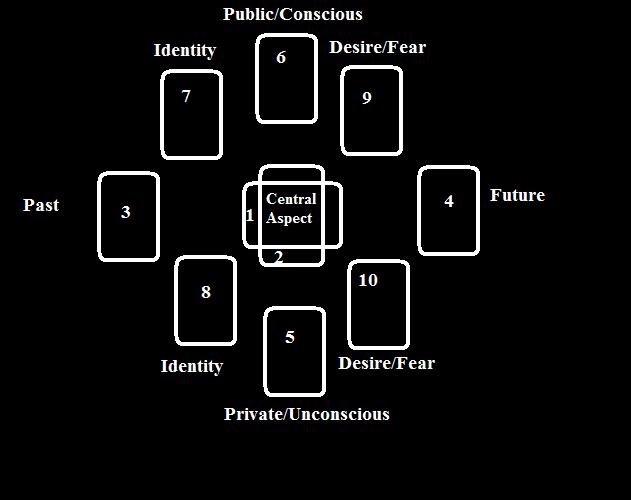
1. Central Characteristic: This card represents the most important part of someone’s personality; it is the card that best describes and sums up the the personality of the entire person. It is both the primary factor and the summary of the rest of the spread.
2. Influencing Characterstic: This card is the second most important aspect of someone’s personality, and influences, mitigates, or complements the Central Characteristic; in many ways it also the secondary characteristic of a person, and provides a second dimension to one’s personality, adding depth to it.
3. Influence of Past: This card sums up the influences that past events have had on one’s personality; memory is an important part of our personality, our desires, and our own identity. This card represents and shows the influence that this memory has had on a personality.
4. Goals of the Future: This card represents what one are striving to accomplish; another aspect of one’s personality is their drive, and what makes them motivated: that motivation and drive is represented by this card, which shows the thing that the person is striving to achieve, and their most important desire for the future.
5. Unconscious Thoughts and Motives: This card represents the unconscious thoughts and concerns of a person, and also represents this person’s motives. It answers the questions of “why do they do this?” as well as those of “what are they really thinking?” This is their unconscious drive (rather than the conscious drive of Card 4), and represents the deepest aspects of their personality, hidden from themselves. This card also serves as the synthesis of cards 8 and 10.
6. Conscious Thoughts and Concerns: This card represents the person’s conscious thought. It helps one examine what the most important things are to this person, and represents their most pressing concerns, and what is most important to them at this time. This card also serves as the synthesis of cards 7 and 9.
7. Public Face: This card is the public aspect of one’s identity; this is how others perceive this person, and how their environment (including other people) affects them and notices them. This card is similar to Card 8 (second from the bottom of the Staff) on the Celtic Cross. This card represents how they want others to see them as well.
8. Private Face: This card represents the concept of self-identity and self-image, and shows how a person really thinks of themselves. This might line up with one’s public face, but often is at least slightly different. This card is similar to Card 7 (bottom of the Staff) of the Celtic Cross spread. This card shows how this person really feels about himself, and what they think their own identity is.
9. Public Desire: This card represents what one says they want; it is the stated hopes and fears of a person. This is what the person wants others to think they want and what they want others to think they are afraid of; this card represents those desires made public.
10. Private Desire: This card represents one’s true hopes and fears; their heart’s desire or their deepest, secret fear. These are the desires that people keep repressed and hidden – sometimes even from themselves – for various reasons. These are the inner passions and repressed terrors that often motivate people’s actions unconsciously.
Middle East Yin-Yang
Right, so I got some time to do a Tarot reading. Earlier, I made a post in which I analyzed the uprising in Egypt using the Celtic Cross Tarot Spread. Now, I aim to analyze the Middle Eastern situation as it currently is – using Joan Bumming’s Yin Yang Spread. Educate yourselves. The question: what are the opposing perspectives in the ongoing conflicts in the Middle East between governments and the people? using the Thoth Deck:
–
Central Matter One: The Empress – Unity. Caring. Motherly. Nurturing. Sensual. Sexual. Nature. Passion. Interesting, as I don’t see this card represented at all really in the situation except for the last. The card isn’t reversed, either, so this card is not representing a lack of something – but the presence of it. I think, in this case, we should be looking at passion, then – which certainly can be seen, especially in Libya, with civil war, a leader desperately clinging on to power, and the people trying to take it from him. The card could also represent the people’s desire to be a nurturing figure to country as an abstract principle; by overthrowing the Western-backed dictators, they are doing a good deed for the country, and allowing themselves to nurture it back to its full potential.
Central Matter Two: Queen of Cups. A personality, most likely, as this is a court card. Cups – emotion figures into it. Queen – the “feminine.” The water of water. Reflectivity, passivity, dreaminess, fantasy. But… this could also indicate distortion of reality – on the parts of the dictators? Qaddafi certainly is guilty of this, with his ideological trickery, and his denial of the unrest – and Ahmadinejad is as well, with his denial of the Holocaust. They project peace to hide the turmoil that lurks within; and indeed, the figure on the card is obscured partly by smoke. Truth being hidden by powerful personalities strikes me here, as tranquility is transmitted – but in the end, the true nature of the country will be reflected when the ripples on the surface of the water cease.
–
Government Official Stance/Desired Impression: Five of Disks – Worry.Instability. Strain. Helplessness? Could this indicate that the stance the governments are taking is that the people are bringing instability to the previously stable countries? This could be argued to be true; maybe the situation was terrible before, but it was stable. The governments might also be arguing that the country has hit upon hard times, which triggered this unnecessary revolution; but whatever it is, unrest and worry is part of the government’s stance. Likely, squelching this worry is also part of it. Alternatively, the government could be expressing worry and concern about this unrest, taking the card’s name literally, and trying to come off as putting the interests of the people at heart, though this may be false; a distortion, perchance?
Government Conscious Thoughts/Ideal Goal: Knight of Swords – Fitting that a court card be here, as the governments are typically strong individuals (dictators). This card, the fire of air, indicates ferocity, managed violence, clever subtlety, and an ideological drive. The dictators in charge certainly are ferocious and violent, but manage these parts of themselves in such a way that they appear only to be acting in the best interests of the people – certainly a manifestation of ideology, yes? And subtle and clever their propaganda and manipulations have been as well, to remain in power for so long. In this position, the government is conscious of these actions, and might even embrace them. However, this card can also represent fragility – the government, having seen others topple, knows that its rule is not unshakable. They can be toppled. As an ideal, the government will take on these characteristics even more so to increase its power.
Government Unconscious Thoughts: The Hanged Man. Things not being as they seem. Suspension. Letting things happen. Perhaps, somewhere deep down inside, the governments have resigned themselves to their fate, and though trying to put off their loss of power, know that it is inevitable, and that things will be turned upside down; and perhaps they also realize that the only way for them to win is to step down peacefully and let the country grow again, though their conscious thoughts prevent this from manifesting.
Government Guidance: The Eight of Cups – Indolence. In order to “fix” the situation, the most relevant meanings of the cards here seem to be surrender and moving on – the government has lost, or will lose. Tying in with the Hanged Man, they should just accept this and move on.
–
The People’s Official Stance/Desired Impression: The Princess of Disks. A persona – the Earth of Earth. Potential, beauty, the ability to create and give birth. That isexactly the image the people want to have – they want to remake their country, to give birth to and create something beautiful;to make it sublime. They see themselves as holding the future, and will make the world a better place.
The People’s Conscious Thoughts/Ideal Goal: Three of Wands – Virtue. Blossoming. Conception. Morality. Leading by example. Foresight. At the forefront of the peoples’ thoughts is the fiery passion if new birth and growth – the development of a new nation, ruled not by the whims of petty dictators, but ruled with the long-term goals of the people in mind; ruled with foresight. This card could also represent that the people are concerned with the morality of the constant situation, and seek to bring an element of humanitarianism in with them. Achieving this state of virtue is their ideal goal.
The People’s Unconscious Thoughts: Princess of Cups [Reversed]. Interesting; to me, a reversed card in an unconscious position reinforces the fact that the thought is unconscious – and perhaps even being suppressed. Another court card, the personality this represents is one of perpetual rapture, romance, inner exploration, and gentleness. These qualities certainly aren’t being expressed; perhaps they indicate suppressed desires? Perhaps the people aren’t looking into their own motives for overthrowing the dictators? Is it that the people want to be able to be happy and live in the wild and joyous abandon of the Princess of Cups, but can’t, which is why they are attempting their revolt? This card is probably the least clear to me – but I am not good with court cards.
The People’s Guidance: Five of Cups – Disappointment. Unexpected disturbance. Triumph of matter over spirit. The latter seems most relevant to me; in the end, though their cries and chants are often ideologically defined, what drives the revolutionaries and will lead to their success is the admittance that what they want is material; they want material, tangible benefits denied to them by the dictator. The question is; will they get these benefits, or will the be disappointed; like they have been Egypt so far with the military? They should be wary of disappointment; they might not get what they expected or wanted.
–
Guidance for Both: Ace of Cups. Emotional force; the birth of emotion. Intimacy. Love. Intuition. Seems simple(ish) to me, and very generic and kind of cheesy; they need to understand and respect each other (intimacy, love). The government should acknowledge the peoples’ wishes, and the people should acknowledge the government’s stake in the matter, and what will be lost. Will this happen? Likely not. Should it? I myself am divided on this. Emotion will play a key role in resolving this conflict; people’s ways of life will change, and with it, emotions will run high. Acknowledging and using these emotions will benefit both sides.
Outcome if Nothing Changes: Three of Disks – Works. Teamwork. Planning. Construction. Competence. A pretty good card, if I might say so myself. If the situation doesn’t change, construction will begin – but construction of what? I took this to mean of new nations, as “construction” does not imply “renovation,” which would have indicated the regime holding on to power. The people will cooperate and work together to build a nation that will function and work well (competence). Maybe, then, the situation should carry on as it is. The government will suffer, but the people will not in the end.
–
So there you have it. Lots of court cards; personalities and strong characteristics of populations will play large roles. They could be indicating the roles of dictators. Lots of cups as well, indicating the charged emotions involved. Also note that the cups that appear (other than the Queen) are in the positions for “guidance” – all sides should, then, perhaps, let their intuition guide them to reach the best possible outcome. Disks are present in both sides’ public images, interestingly; both sides want to be seen as offering the practical solution, and to be seen also as being grounded in reality. When thinking about this reading, I was drawing mostly in Libya – were my thoughts guiding me to the next major site of change in the Middle East?
Well, there are my thoughts on the matter reflected in the cards. Think about it while I get some sleep.
Middle East Celtic Cross
At the suggestion of my mother, I decided to throw a spread to look at political problems. Now, you’ll have to forgive my interpretations’ possible lack of accuracy in terms of factual events (also note that my political beliefs are not expressed in these cards), but using a ten-card Celtic Cross spread asking about the current uprisings in Egypt, I achieved the following (using Rider-Waite[-Smith]):
Root Cause: Temperance [reversed] – Indicating to me that the problem was an inability to calmly go about affairs – possibly overreacting protestors or a government failing to use moderation to govern the country, being too hard upon its people.
Contributing Factor: Nine of Pentacles [reversed] – The presence of two blocked cards at the heart of the matter seems to be to suggest frustrations and unrealized potential on both sides. This card seems to me to suggest that people may be working hard, but aren’t getting the rewards they wanted (the Nine of Pentacles, to me, indicates the process of hard work leading to a reward and a time of rest and contemplation). Perhaps frustration that the government won’t step down after the hard rioting of the protesters (or perhaps that the government has been taking the earned rewards of the people), or frustration that the rioters won’t give up on the part of the government? Combined with the reversed Temperance, perhaps this is what is causing the lack of moderation to be present?
Receding Influence: Seven of Swords – Depicting a man fleeing with what appear to be stolen swords, this card to me indicates that the time of flight and theft is over – the time of the government taking from the people is over, the time of hidden atrocities and dinhonours is over, and the time of the people fleeing from these problems is over.
Approaching Influence: The Hierophant – The second Major Arcana to appear (Temperance being the other) – after the events of this riot are over, perhaps Egypt will be inducted into some formal new society, or will have learned a valuable lesson? If the government wins, a lesson might be learned about the power and will of the people, and if the rioters win, perhaps this indicates that the new government will be accepted into the global community.
Conscious Influence: Seven of Cups – Choices. Some degree of confusion. Fantasy. Perhaps indicating, in this position’s role of what is superficial, that the government is either clinging to a fantasy of being able to hold power, or that the rioters are holding on to a fantasy of overthrowing the government. My own thoughts on the matter cause my opinion to lean more towards the former than the latter. Perhaps this also indicates that the situation is not as clear-cut as everyone in the West makes it out to be: the government either falls or doesn’t. Perhaps the government has realized this, as can be seen by their efforts at talks. There may be other choices available to end the conflict; governmental integration, concessions made by both sides, and doubtless other things I have not thought of. Confusion might come from the thoughts of the Western powers – Egypt is an ally, and while Mubarak’s regime was brutal and a democracy fits in better with their ideals, they are afraid of losing an ally and the possibility of a radical Islamic government.
Unconscious Influence: Judgement – The third major Arcana to appear in the cross – indicating that this uprising might have large consequences, such as we have seen hinted at in Yemen, Syria, and Jordan. Beneath the surface, some form of rebirth is at hand/is ongoing – Egypt will not emerge unchanged from this struggle. Issues of identity torment the nation, and perhaps on a deeper level, the nation is attempting cleanse itself of the oppression of the Mubarak regime and be reborn “free of sin.” Perhaps this need to remake the nation and start again also lies at the heart of this unrest.
For the next two cards, I have modified the bottom two cards of the Staff slightly – the bottom card now represents the government’s view (being at the “base” of the country), and the the one above the protesters’.
Government View: Three of Pentacles [reversed] – Normally this card represents teamwork; working together to meet some goal. Blocked, this seems to mean that this is not longer working – perhaps the government feels its allies are forsaking them (such as the Western governments), or that some unwritten agreement with the people to keep the country running is floundering.
Protesters’ View: Six of Pentacles [reversed] – Again, the earthy, practical nature of the Pentacles surfaces with regards to the viewpoints of the opposing sides. This struggle perhaps isn’t about abstract ideals; it’s a practical matter for both sides: the government wants to keep its power, and the people want to have better lives. The second reversed card also implies lots of frustration. But looking at the actual six itself, this seems to me that the protesters view this struggle as the government failing to balance the haves and have-nots; the Six of Pentaclesfor me has always been a problematic card, especially reversed. To me, this card normally represents the inequality in the world, but in the Ride-Waite deck, the presence of the man distributing some of his wealth to the less well-off can also indicate some sense of balancing the inequalities – perhaps the people feel that the government has failed to this (the reversal), and so want to do this form themselves.
Possible Solution: Three of Wands – To me, this card represents striking out into new territory, thinking ahead, and the qualities of leadership. Something to keep in mind for both sides, then, is that strong leadership will be needed – and looking at Mubarak’s current precarious position, it may very well not be him. In terms of exploration, perhaps a new, untested agreement will have to be put in place to resolve the conflict. The thinking ahead bit speaks for itself, really – if this is uprising is going to end well for everyone, everyone will have to be thinking ahead. Mubarak, very aged at 82, might not be thinking this way – perhaps this card indicates that he should, and begin thinking about Egypt after his death/resignation. In the same vein, the protesters should think about the long-term effects of their actions and make sure that they know what they’re doing – and should come up with a plan for what to do after Mubarak resigns; something I have not heard much talk about.
Likely Outcome: Justice – The fourth major Arcana to appear. Momentous events indeed. This card indicates, to me, that weighty decisions will be made, karma will come into effect, and order will be restored. This could quickly be seen as Mubarak will get what he had coming for his oppression and will fall – but The Tower would indicate this to me more than Justice. After all, despite oppression, Mubarak did hold the country together and was a “bastion of peace” in the Middle East, and a representative of moderate values (look back to the reversedTemperance here – maybe these values were no longer holding up?). To me, this just indicates that the situation will turn out well and everyone will get what it is they deserve – what exactly that is, I cannot say.
Though all four suits (Wands, Cups, Swords, and Pentacles) were present, the Pentacle dominated. In the end, the unrest in Egypt might not be so much about ideologies and grand ideas, but rather about simple and down-to-earth needs and desires: the conflict of power and satisfaction, of oppressor and oppressed.
The Emperor and the Star
As I have been thinking about Aleister Crowley’s Book of Thoth and his thoughts on the relation of the Tarot to the Tree of Life, I found I disagreed with him on one point – he put the Emperor (IV) as the connection between Netzach (Bliss) and Yesod (Essence of Being), and The Star (XVII) as the connection between Chokmah (Original Harmony) and Tiphareth (Experience). Now, his argument is based on linguistic and numerological arguments that go way over my head, but I am looking at this purely through my own philosophical standpoint.
To me, just thinking on the surface(ish) side of things, the connection between the Sefirot of Chokmah and Tiphareth should be representative of the active and powerful emanation of Chokmah – commonly associated with the male (as opposed to Binah, the passive, receptive female where creation occurs after receiving Chokmah’s seed – note that these terms are not representing what I think of men and women, but is representing symbolism primarily drawn from the Tanakh – or for those less knowledgeable of Judaism, the rough equivalent of the Bible‘s Old Testament) – exerting its will on the consciousness that is attained through experience (Tiphareth). This will to me would be better represented by the Emperor, not the Star – the Emperor as the “father” figure, the single stern authority who provides order from above. Additionally, putting the Emperor here would put him opposite The Lovers (VI) – which represents duality and intimacy, and in a way reflects the spirit of Binah, as the connection where Crowley places The Star should represent Chokmah.
One could argue that the Star provides light from above as a form of symbolism, but I see that as more of the symbolism of the Sun’s (XIX) role – and the Sun in its current placement is opposite the Emperor; would it not be better for the Star, which can be argued to have a similar function, to be opposite its closest example? The best placement for divine light from above, however, is the connection from Kether (The Spiritual Seed/Emanation) to Tiphareth, which is represented by the Priestess (II). This is fitting, as the Priestess serves not only as a passive figure, but also as the mysterious secrecy that lies behind the veil; she herself as a figure can be seen as Kether, the veil the abyss (in which dwells Daath and separates the supernal triangle from Tiphareth), and the viewer as the consciousness of Tiphareth. She, as a priestess, is herself “divine” in a sense, and also at the same time by her human nature more earthy and conscious in that sense; she then very well represents the bridge from the spirit to the “center” of the Tree of Life.
The Star, on the other hand, currently occupies the Emperor’s positions in Crowley’s layout, between Chokmah and Tiphareth, as mentioned earlier. The Star would better fit between Netzach and Yesod – Bliss and Essence of Being. Why? The star represents a calm serenity and a sort of dreaminess – that which is associated with bliss – and also with a sort of bringing down from above (just look at the image on the Thoth cards of Nuit, bridging the gap between high and low) and a sort of guidance, but in a different way than the Emperor’s stern imposing of order. More of a nudging or actual guide than a bring of order, which the powerof Chokmah seems to say to me. The more gentle “Bliss” aspect of Netzach, coming down to guide Yesod (Crystallization and Essence of Being), and providing the best possible help for what can be argued (except in the case of Swords) is the best of the Sefirot. The additional hunt that Nuit as a Goddess is doing the guiding also seems more fit for this happier, “better” connection.
At least to me. Crowley had his points, and from my more limited view, I disagree – plus this puts the Roman numerals back in order. I have adopted this variant form to use in my tarot readings now.
Two New Tarot Spreads
I recently just tried two new spreads, and was happy with one and not so much with the other.
The one I was not so happy with was a fifteen-card spread I decided to try based on the little booklet included with my Thoth deck – with five groups of three cards, one representing the heart of the matter, two representing different futures, one indicating the implications/psychology of the individual querent, and the last telling of larger forces. The main problem I had with it is the presence of the two futures indicate more divination than I am comfortable with, and the whole set-up just seems too simplistic, and the presence of three cards for each issue makes things murkier than they need to be. It was neat, however, to be able top modify the strengths of the central cards based on the influences of the flanking ones. I had a few interesting readings, but in the end, it didn’t call to me.
The second one I tried was Joan Bumming’s Yin-Yang spread. I asked the same question of this one (I tried the question with Celtic Cross, Fifteen-Card, and Yin-Yang), and I felt like it gave me the better answer. It was clear, concise, helpful, and very well-designed. Interpreting the cards came with no real difficulty and it almost seemed as if the spread was tailor-made for the conflict I was examining. I think I may have a new spread to often use along with the Celtic Cross I think. I will be examining this one further, then seeing what happens when I look at some of Raven’s spreads.
The Tarot
The Tarot are representatives of our life-course and the world around us. In theTarot Challenge, I will be going through each of the seventy-eight cards and explaining to my fullest ability what each card means to me. As the cards are largely subjective, they mean different things to different people. My thoughts on the cards come from two major sources: the first is my interpretations of the deck I learned to read Tarot with, the Rider-Waite deck, and the second is my interpretation of the Thoth deck and the cards’ relation to the tree of life. For the more practical interpretation of each card, I lean more on the meanings of the simplistic artwork of the Rider-Waite deck, but for the more abstract and deeper voices of the cards, I lean more on Crowley’s Thoth deck and his (and my own) interpretations of the Tarot with regards to the Sefirot and the Tree of Life.
The way that I envision the Tarot is as a divided representative of the Tree of Life; the Kabbalistic idea of how the divine energy of EinSof flows from heaven to earth, manifesting itself. Each numbered card in the suit, 1-10, represents one of the ten Sefirot; Kether, Chokmah, Binah, Chesed, Geburah, Tiphareth, Netzach, Hog, Yesod, and Malkuth. The meaning of each of these Sefirot and how they apply to the cards, as well as words on the organization and nature of them, will be delved into in more detail after I finish discussing each card. The suits of each card shape the way that each numbered card manifests the Sefirot they represent. Additionally, each Sefirot represents a number in the Naples arrangement: Position, Line, Plane, Matter, Motion, Experience, Bliss, Knowledge, Being, and Reality. Essentially, each Sefirot represents one level of the world’s – and life’s – basic construction.
The four court cards in each suit correspond to a particular Sefirot as well: Kings are Chokmah (the active male), Queens are Binah (the passive female), Princes are Tiphareth (Experience), and Princesses are Malkuth (Reality). Again, the suit of the court cards also reflects how they express each Sefirot; each court card also represents distinctive personalities we may see in ourselves and those around us, and between them all cover most aspects of personality that we see.
The Major Arcana, on the Tree of Life, are placed between each of the Sefirot. As such, they represent the paths the energy from EinSof must take to reach the Earth. In this sense, they also reflect the natures of the Sefirot that they connect. Additionally, when number 0-XXI, they tell the story of one’s life from a baby to their integration with the world.
Keep in mind that throughout this whole challenge I will be referring to “male” and “female” dualities and characteristics. Due to my sociological training, this is hard for me in many respects, so here I would like to emphasize that I acknowledge that gender is not binary but rather is a spectrum, nor is there any “right” way to do gender. I am merely using the antiquated terms philosophically.
Tree of Life Spread
Tree of Life Spread – Not Mine!
I recently joined the Aeclectic Tarot Community and have since been browsing peacefully among their forums. I quickly came across a new and interesting spread that I have recently tried out. The spread is linked above; I won’t give you a description here. If you’re a member yourself, you can view the finalized version I used.
My initial thoughts on the spread were that it was very interesting and seemed well-thought out and organized. Cards 2 and 3 in particular rang with me (in the positions of Chokmah and Binah, respectfully), with them representing the force and the form of the issue (again, respectfully). The one position there that I feel is iffy is 10; I m always leery to ground the Tarot too much in the material (it’s a very Swordsy hobby), but the card’s position kind of makes that interpretation necessary. As such, I don’t know what to do with it, so I’ll just leave it as is.
My reading was lacking in a few places, but unerringly accurate in many others. I will have to refine the definitions of each position a little bit, but I am already a fan of this spread.
Court Card Equivalencies
I was just reading Pyraeus‘ articles on Court Cards, and quickly noticed that the website equates Princes from the Thoth deck with Kings from the Rider-Waite. I was struck by this, as making that connection had never occurred to me, and as I thought about it, some of it made sense – and some of it did not. Certainly I had noticed that many of the Knight Cards across the two decks shared similar meanings – and even names – but I still felt like something was not quite right about the match-ups. After some pondering, I came to the conclusion that the two court card systems are really so completely different as to not really allow for good comparison. The Rider-Waite court cards – to me, at least – seemed to focus on the Wisdom of the Kings, the Competence of the Queens, the Activity of the Knights, and the Enthusiasm of the Pages. The Thoth system emphasizes the Kabbalistic and elemental system of the court cards, taking different aspects of each element to assign personalities to the cards. The Rider-Waite cards, then, to me always seemed to represents different aspects of their suit, but in a vastly different way when compared to the way the Thoth deck does it.
As such, for my Tarot Challenge, I will continue to do it as I have been (I only have one more Court Card left, anyway), but say now that the two systems really cannot be compared in any way.
Princess of Disks
Princess of Disks: The Strong, Pregnant Woman
The Princess (Page in the Rider-Waite tradition) of Disks is the card representing the personality that arises from the Earthy part of Earth. It symbolizes the kind of person who represents the Earth of Earth; the most stubborn, materialistic, practical person you’ve ever met. She also represents the end of the cycle, and the start of the new; while the Knight of Wands represents the person who goes out and creates things in the world, the Princess of Disks is the person who givesBirth to the Knight. She is the soon-to-be-mother; the pregnant woman. She represents the Potential of life, and Ultimate Womanhood. She is the force that stands behind the force of Creation, who Carries the Future with her. She is alsoStrong and Beautiful, in both human and Earthy terms, making her also Sublime. She is on the Brink of Transformation. She represents the ability of the Earth to give birth to new life (while the Queen of Disks represents the Earth’s ability to care for this life).
She is also extremely Stubborn and Thoughtful, able to survive by applying herPracticality, and doing anything to protect the future that she holds in her womb. She will not take needless risks, and can move mountains to get her way, and will not let anything stand between her and what she needs.
The Rider-Waite art shows a young man looking at a Pentacle in his hands, as if considering what he can do with it. Similar signs of potential and growth surround him in the green grass and trees in the distance, as well as sublime mountains in the background. The Thoth illustration shows a woman with horns (signifying fertility) looking down at her swollen stomach (indicating pregnancy), while cradling a flowering Disk with a Yin-Yang (symbol of balance and completion) in one hand. In her other is a spear, pointed at the ground, and it looks as if it has just been used. Power flows out from it, and she stands upon what is either a rock or a slain beast. She will use her spear to defend her unborn child, and will let nothing get in her way. Behind her, trees grow larger like the child in her womb does.
In a reading, this card asks you to examine the role that people with this personality play in your life. Do you know anyone who has lots of potential, and seems to hold the key to the future? Who is strong, beautiful, and doesn’t take any nonsense from others? Reversed, this personality’s energy is twisted or hidden somehow; their potential could be hidden somehow, or perhaps this potential is not a positive thing for the future.
Prince of Disks
Prince of Disks: The Ponderous, Unstoppable Problem-Solver
The Prince of Disks (Knight in the Rider-Waite tradition) is the card representing the personality that arises from the Airy part of Earth. He is the abstract and principled aspects of practicality and steadiness. As such, he is a little bit of a contradiction; he represents the two sides of the dichotomy of Air and Earth coming together in one being.
As such, the Prince of Disks excels in Practical Knowledge, and Lacks Emotions. He is prone to slow, Ponderous movement and is also Meditative. He has both the mental force of Swords and the physical force of Disks, and so quickly can becomeUnstoppable. He thinks things through before doing them, and so is Thoughtful, and also Ingenious, able to apply to apply his ideas to the real world and Solve Problems. He is Trustworthy, Solid, and Dependable. He is actually veryEnergetic, but only when he becomes driven to be so, a process which takes a long time; he is Slow to Anger, but when angry is Fierce. He is also Slow to Change is Mind and a Slow Learner, but he still does learn, and Grows slowly and steadily. He is a hard and Steady Worker, and a Competent Manager; he can apply his ideas to reality when he needs to, though he does not excel at it like the Princess of Swords does.
The Rider-Waite art shows a knight, halted and carefully inspecting a Pentacle held in his hand. This card mirrors closely the Thoth deck’s Knight of Wands, and indeed even shares the same name, and has many of the same meanings. His horse represents the idea of powerful movement, and his heavy armour some degree of caution. The Thoth illustration shows a naked man holding a disk riding s chariot pulled by a fearsome-looking oxen of some kind. The chariot (and the ox) looks very heavy, and its motion is the very definition of what this card stands for; slow to get going, but impossible to stop and very difficult to change direction once it gets going. He is surrounded by symbols of plants; emphasizing the diea of slow but steady growth, as well as stability and dependability (the stable build of the chariot also reinforces these ideals).
In a reading, this card asks you to examine the role that people with this personality play in your life. Do you know anyone who thinks slowly, but once set on a task will complete it at any cost, and woe to any that try to change his mind? Anyone who can solve any problem given enough time? Reversed, this card’s energies are hidden or blocked; perhaps they are not quite unstoppable, or they may put on a show of bravado about how they can do anything and no one can stop them, but back down at the first sign of strong opposition.
Queen of Disks
Queen of Disks: The Helpful, Discontented Hostess and Mother
The Queen of Disks. This card represents the personality that arises from the Watery part of Earth; the passive, intuitive, emotional part of the practical and down-to-earth individual. She is a people-person, who enjoys life and the company of others. She is pleasant to be around, and works hard to get what she needs, and then does not hesitate in enjoying what she has. She has a great knowledge of the practical side of human emotions and feelings, and is able to and often willing to help people with their problems.
The Queen of Disks is Charming and Bighearted, and often acts like a Mother Figure. She is Affectionate and can also be Sensual, concerned with the physical and material nature of human interaction. She is given to being Sexual as well frequently, and has a desire to please her body physically. To these ends, she can also be Seductive, but she does not use her abilities to seduce for her own personal gains; she does it merely to please herself. She is often Quietly Ambitious, but appears to others to be Servile due to her constant helping of others. She is the perfect hostess. She does not scheme or plot in her ambition, but instead Works Hard to get what she wants, always in the Background and out of sight. While she can help other people understand how they feel about themselves and the world, she herself is often rather Dull, and she is not a particularly good entertainer. She is a marvelous teacher. She may sometimes feel Trapped by her standing and Long to go out and be more useful. She often possesses great practical knowledge, and is Sensible when she needs to be. However, she is also often given to Foolishness when in the company of her friends, and sometimes gives in toLust and Debauchery. Everyone enjoys being around her, and she works hard to please others to increase her own standing with them, and through them, her standing in the world. She herself will not advance farther, but her actions will help others succeed.
The Rider-Waite art shows a kind-looking woman fondly looking down at a Pentacle she is cradling in her lap. She is caring for it like a mother, and is also surrounded by images of growth and fertility. She herself will not grow further, but she will help others to grow. She also wears an expression of slight discontent, as if she is slightly unhappy with her position, and only gets to live through her children. The Thoth art similarly shows a seated woman cradling a Disk in her arms, but she only seems half there; she gazes longingly off into the distance, wishing for something she will not achieve. A statue of a goat – symbolizing fertility and potential – stands beside her, indicating that those that she rears and teaches will have great potential. Her crown also bears two spiraling horns, emphasizing the idea of continuation (the spiral horns symbolizing infinity) through others. She is surrounded by growth, and yet she herself does not grow.
In a reading, this card asks you to examine the role that people with this personality play in your life. Do you know anybody who seems stuck in his or her life, but does all they can to help others move forward? Anyone who longs of doing better things but seems stuck in a rut? Who others ignore and count as part of the background, yet depend on him or her absolutely? Reversed, this card’s energies are hidden or twisted somehow; perhaps this person hides their discontent very well, or her silent ambition is leading her to send others down the wrong path.
Knight of Disks
Knight of Disks: The Industrious, Cautious Entrepreneur and Father
The Knight of Disks. The King of Swords in the Rider-Waite tradition. This card represents the personality that arises from the Fiery aspect of Earth; the active, bold, and creative personality of the practical and down-to-earth person. This is the card representing the personality that will lead that person to great Gain and eventual Wealth, using Power to create great Works. This is the outspoken, stubborn individual concerned with succeeding in the world. In the traditional “breadwinning” family, this card represents the breadwinner and Father Figure, who provides for his family and sustains it.
This person, then, has experienced great Material Success, and has much Wealth. They did not inherit it all; they are not spoiled heirs or heiresses. They earned it through their Industrious behavior and their Competence. They are Capable andEnduring; they won’t give up until they have succeeded. They are the fire that never goes out, and the landslide that does not stop until it has reached its destination. They are dedicated to Laboring for gain, and are sometimes overly (or at least extremely) Materialistic. They can be very Patient; these are the people who can work there way up to great wealth from nothing through hard work and never-ending patience. They do not rise up quickly, but they do rise; they prefer Slow Growth to a meteoric rise, arriving unobtrusively at the site of power. They can sometimes be of Low Intellect, knowing only how to make gains; they may be exceedingly Narrow-Minded or only able to do things by the book. They Look Ahead and Consolidate Their Gains as they move forward, as they are very Cautious. They have Little Initiative and prefer to take the tried-and-true path to gain as opposed to taking risks. However, if the risk is not too extreme and promises great gains, they are often willing to take that chance, for no man who earned his own fortune got there without taking any risks; it’s a matter of taking carefully calculated risks.
The Rider-Waite art shows a man sitting on a throne surrounded by impenetrable stone and lots of green plant life, his robe colored with images of green leaves. He has gotten to where he is through slow growth, like the mighty tree, saving up a little every day. He owns a large castle seen in the background, and is calm and secure in himself and his future. He is the younger version of the man we saw in the Ten of Disks: Wealth. The Thoth art shows a man on a still horse, looking offahead into the distance, pausing to rest and plan his path carefully. While he looks one way, his horse looks the other way, keeping them both safe, emphasizing caution. His weapon is a club; he uses brute force to get his way, as opposed to trickery or more subtle plays, like a sword would require.
In a reading, this card asks you to examine the roles that people with personality may play in your life. Do you know anyone who works hard, plans out their every move carefully, and only takes carefully-calculated risks? Reversed, this personality is hidden or twisted somehow; maybe a friend’s showy acts of courage are not quite as courageous as they appear, or their gains are not achieved through hard work and industry – or maybe their hard work has not yet been rewarded.
Ten of Disks: Wealth
Wealth: Material Success, Establishment, and Restlessness
The Ten of Disks. Wealth. Material Success. Performance. Establishment. Restlessness. Jealousy. Permanence. Greed. Boredom. Dissatisfcation. Having it All. The Futility of Having it All. The Ten of Disks corresponds to the Sefirot of Malkuth: Reality, the Root, the Sum, and the Origin. The Ten of Disks represents what happens when the energy of practicality and the material world interacts with… reality and the material world. As such, as these two ideas are harmonious with each other, the Ten of Disks is more positive than the other three Tens (Oppression, Satiety, and Ruin). The Ten of Disks represents what happens when someone filled with practical wisdom, prudence, power, and the ability to work with others and to shift and change with the times lives and interacts with reality. This card represents the final culmination of the Suit of Disks when applied to reality, and it results in Wealth for the exemplar of Disks. They havePerformed their roles well and been rewarded for it; even if their heart isn’t in their Performance. They have had great Material Success, and have been able toEstablish themselves and their descendants as important. In this sense, the idea of Malkuth as being about rebirth becomes apparent as well; passing on one’s wealth to one’s children starts the cycle of material gain again, keeping the energy of Disks alive.
This card, then, represents Having it All, but also represents the negative consequences of it as well. You may have everything, but others may beResentful of it, or Jealous. You may not be able to stop your desire to accumulate things, and may become Greedy or perhaps Restless and Dissatisfied; you have had Material Success, yes, but what about spiritual, emotional, intellectual, and purposeful fulfillment? In this way, this card also represents the Futility of Having it All; this card serves as a reminder that there is more to the world than the material.
The Rider-Waite art shows an old man, with two of his descendants before him, hinting at ideas of Permanence and Establishment; his line will live on. He lives in great luxury, wears fancy clothes, and even has two dogs attending to him. He has succeeded in life. Yet at the same time, he isn’t really doing anything – he had it all, so he has nothing left to do. He is Bored. The Thoth art shows ten Disks arranged in the shape of the Tree of Life, representing completion. As the last numbered card of the final Suit, this card has a special meaning with regards to the Sefirot, as finishing the cycle – and starting it again. Behind these ten bright coins/Disks is a pile of other coins, representing having lots of wealth.
In a reading, this card asks you to examine the role of Material Gain in your life; have you or anyone near you experienced it? Do you consider yourself wealthy? Do you have everything you wanted (materially), and yet still feel dissatisfied? Do you feel as if you’re performing a role you don’t really feel in order to obtain material wealth? Does your heart lie somewhere else? Reversed, this card’s energies are blocked or twisted somehow; is your wealth inaccessible? In areas you wouldn’t normally look? Are you wealthy and satisfied?
Nine of Disks: Gain
Gain: Discipline, Refinement, and Receiving the Fruits of One’s Labor
The Nine of Disks. Gain. Refinement. Self-reliance. Discipline. Getting Things. Receiving the Fruits of Your Labor. The Nine of Disks corresponds to the Sefirot of Yesod: Crystallization and the Essence of Being. This card’s energy represents the best the Suit of Disks has to offer, and is the resolution of the two weaknesses of the Suit of Disks. This card represents the recovery from Failure by using the appropriate amount of Prudence (not too much). Once one uses Prudence to make up for their faults as seen in Failure, they will begin to Gain. WhilePrudence represents the labor that goes into making something happen,Gain represents to the Fruits of That Labor, and the act of enjoying andReceiving them. With regards to the Suit of Disks’ Crystallized Essence of Being, this card represents one’s essence of they adhere to the ideals of the Suit of Disks; they are Disciplined and Self-reliant; they can make their own way in the world. This person is also Refined and civilized, as s/he knows how to succeed in the world and Gain from it. This card represents the energies associated with succeeding in the world, and the good things that come from it; this card is the sum total of the Suit of Disks, and represents the best the suit has to offer.
The Rider-Waite art shows a successful young woman, dressed nicely and in a well-maintained garden, with a hawk on one arm. Grapes are growing behind her. She has been productive, and has tamed her inner ferocity (as represented by the hawk). Her garden and serene pose are all symbols of her discipline, and she stand by herself, indicating her self-reliance. The Thoth art shows nine disks arranged on a colorful background of greens, yellows, blues, and browns. The colors all radiate out from the central three Disks, indicating a burst of growth that one can harvest and cash in on, as indicated by the other Six Disks on the periphery.
In a reading, this card asks you to examine the role of receiving the rewards of hard work in your life, and suggests that you look at your degree of self-reliance, discipline, and refinement. Are you able to stand on your own? Do others consider you polite or civilized? Do you belong to the elite cadres of society? Have you been working hard to receive your rewards? Reversed, this card’s energies are blocked, hidden, or twisted somehow; is one’s outward civility masking a deeper bestiality? Have they gained from the labors of others? Are they trying to be self-reliant but failing?
Eight of Disks: Prudence
Prudence: Attention to Detail, Caution, and Hard Work
The Eight of Disks. Prudence. Detail. Diligence. Micromanagement. Hard Work. Thrift. Putting a Little Aside. Beginnings of Advancement. Caution. Too much Caution. Being Miserly or Stringy With Resources. Practical Wisdom. The Eight of Disks corresponds to the Sefirot of Hod; Knowledge, Structure, and the Intellectual Weakness of the energy of the Suit. It is the reaction to the degenerate, more emotional weakness of Netzach. When one sees the corruption and lack of success and prosperity, the immediate reaction is to immediately watch what you do more carefully, exercising Caution and Thrift. One will manage their resources better, and Work Hard and be Diligent. They will micromanage everything and pay attention to Detail. They will then Begin to Recover and Advance, and Put a Little Bit Aside. This card represents the logical reaction to Failure: Prudence.
In addition to the Intellectual reaction, this card represents the Intellectual Weakness. This card can also then mean too much prudence; being Stingy with money, not willing to give, having Too Much Caution, and losing yourself in the details and Micromanagement. It can represent the beginnings of success, but only when not taken to extremes.
The Rider-Waite art shows a man working diligently on a series of coins; he is focused and paying attention to the detail of the coins, ignoring even his frayed clothing (hinting at the idea of focusing too much on your task). The Thoth art shows a tree growing strong, with eight Disks as flowers on branches. It looks big and strong, but the branches are somewhat twisted and the sky behind it shows the light of a harsh sun. Despite the heat and drought, the plant will flourish; but this card then also has a slightly ominous tone, and warns that the world is not fair.
In a reading, this card asks you to examine the role that prudence, thrift, caution, and careful use of resources play in your life. It could advise you to consider being thrifty, or warn that you are being miserly and not generous enough. Are you paying too much attention to details? Have you been working hard? Reversed, this card’s energies are hidden or twisted somehow; is your hard work helping you progress or is it just busywork? Are your gifts to others cheap and miserly? Is your hard work and diligence paying off?

 EsoTarot